What people actually save: a data study (2026)
What people actually save, measured: 558 videos, 622 saves and 358 searches on SavedThat. Short-form wins the count, YouTube holds 90% of the spoken words.
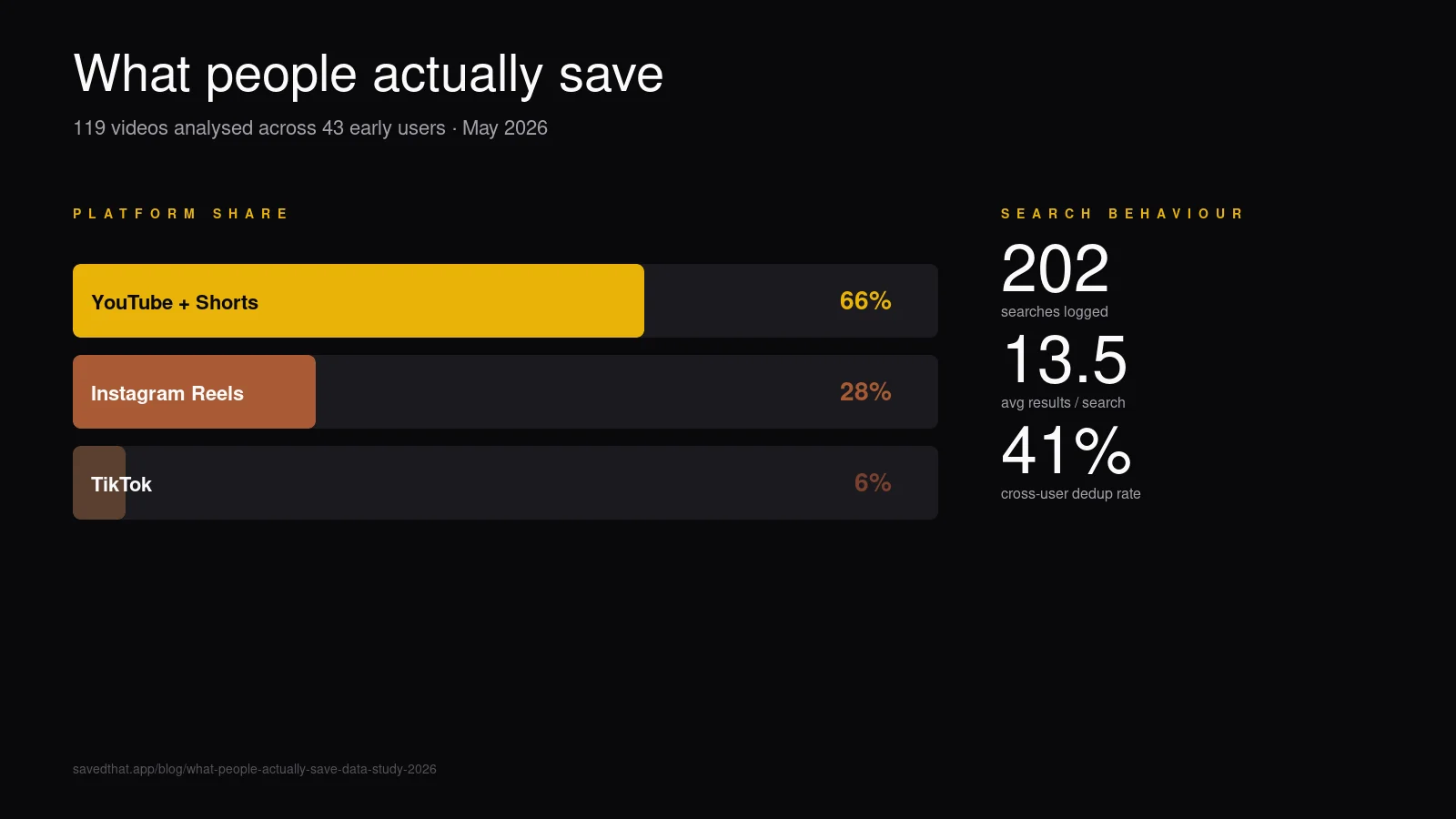
Most writing about what people actually save is vibes. This is a query. In May 2026 we published the first snapshot at 119 videos; this is the same query re-run on 21 September 2026 against a corpus 4.7 times larger, and the headline finding has inverted.
Four findings, in order of how much they surprised us:
- The platform mix flipped. In May, two-thirds of saves were YouTube. Today short-form is 76 percent of saves by count and YouTube is 24 percent.
- The flip changed nothing about the workload. YouTube is still 90 percent of the transcript text and 82 of the 89 hours of spoken content. People save many short videos and a few very long ones.
- Zero-result searches halved, from 16 percent in May to 8 percent over the last 90 days, without any change to the ranking code. The corpus grew into the queries.
- Roughly one save in eight is a duplicate of a video someone else already saved, which is a cost line, not a vanity metric.
The dataset behind what people actually save
- Videos analysed: 558 with status
ready, takedowns excluded, as of 21 September 2026. Three rows sit infailedand are excluded. - Bookmarks: 622, against 539 unique pieces of content (several users can save the same video; the transcript is stored once).
- Registered users: 121, of whom 52 have saved at least one video.
- Searches logged: 358 all time by 31 users; 119 of those in the last 90 days by 17 users.
- Indexed chunks: 24,899, of which 20,703 come from speech and the rest from visual understanding.
Of the 558 ready videos, 439 arrived after the May snapshot. That is what makes this a re-run worth publishing rather than a rounding update: four-fifths of the data is new.
One caveat we are keeping front and centre. This is a young B2C product, and the cohort is self-selected. Patterns at 558 videos are directionally useful and statistically thin, and the platform mix in particular tracks who signed up this quarter.
Platform mix: short-form won the count, YouTube kept the content
| Platform | Videos saved | % of saves | Median duration |
|---|---|---|---|
| Instagram Reels | 349 | 62.5% | 0:46 |
| YouTube | 133 | 23.8% | 21:28 |
| TikTok | 61 | 10.9% | 1:26 |
| YouTube Shorts | 15 | 2.7% | 0:52 |
In May the same table read 66 percent YouTube and 28 percent Instagram. The reversal is real and it happened at a specific moment. Grouped by month, April and May saves ran roughly two YouTube videos for every Reel; from June onward Instagram alone has outnumbered YouTube every single month, peaking at 87 Reels against 4 YouTube videos in June. That is a statement about who signed up this summer, not about video. Medians are computed over the 539 videos where a duration is recorded; 19 videos, mostly Instagram, never returned one.
The medians are the part worth keeping. A saved Reel runs 46 seconds. A saved TikTok runs 86 seconds. A saved YouTube video runs 21 minutes and 28 seconds, and the mean is 39 minutes because a tail of two-hour podcasts pulls it.
The ratio that decides the engineering
Counts mislead, so measure the text instead. Summing the characters of every speech chunk in the corpus:
| Platform | Transcript characters | % of spoken content | Hours of video |
|---|---|---|---|
| YouTube | 4,766,365 | 90.2% | 82.2 |
| Instagram Reels | 385,872 | 7.3% | 5.1 |
| TikTok | 118,960 | 2.3% | 1.7 |
| YouTube Shorts | 12,297 | 0.2% | 0.2 |
One platform holds a quarter of the saves and nine-tenths of the words. That gap is why what people actually save is a misleading question on its own: by count this is a short-form product, by content it is a long-form one, and the two answers imply completely different indexes. A search hit is far more likely to land in a YouTube video than the save counts suggest, simply because that is where the sentences are.
Duration: most saves are short, most minutes are not
| Duration bucket | Videos | % of total |
|---|---|---|
| Under 1 minute | 259 | 48% |
| 1 to 10 minutes | 185 | 34% |
| 10 to 30 minutes | 49 | 9% |
| 30 to 60 minutes | 22 | 4% |
| Over 1 hour | 24 | 4% |
The bimodal shape we described in May is still there, but the lower hump has swallowed the distribution: nearly half of everything saved is under a minute. The 1 to 10 minute bucket, which we called the unowned middle in May, has grown from 24 percent to 34 percent and is now the second largest.
That middle bucket remains the one nobody builds for. YouTube's Watch Later treats an 8-minute explainer like a 90-minute lecture, and the highlight tools treat it like a 30-second clip. Neither is how people use it. If you save a lot of them, making saved YouTube videos searchable is the only retrieval path that scales, because nobody re-watches an 8-minute video to find one sentence.
How people search what they saved: five words, and 8 percent find nothing
Over the last 90 days, 17 users ran 119 searches. The shape of those queries:
- Median query length: 5 words. The mean is 5.4 and the longest was 25 words.
- 66 percent of queries are four words or longer. People type the sentence they half-remember, not a keyword.
- 19 percent are single words, usually a topic rather than a quote.
- Average results returned: 10.2.
- Zero-result searches: 9 of 119, or 8 percent. All time the figure is 13 percent.
The zero-result rate halving since May is the number we would defend hardest, because we did not touch ranking to get it. A query fails for three reasons: the video was never saved, the transcript is thin, or the query language sits too far from the transcript language. The first cause shrinks automatically as libraries fill, which is most of what happened here.
The five-word median is the load-bearing fact for anyone building this category. Five-word paraphrases are exactly the queries a keyword index cannot serve, which is why the retrieval side is hybrid rather than keyword-only: a person who remembers "the bit about salting pasta water" is not going to guess the creator's title.
The videos with nothing to transcribe
Not everything that gets saved contains speech. Across the corpus, 30 of 558 videos, or 5.4 percent, came back with no usable spoken content: silent recipe montages, text-on-screen listicles, pure music.
| Platform | Ready videos | No usable speech | Share |
|---|---|---|---|
| TikTok | 61 | 6 | 9.8% |
| Instagram Reels | 349 | 23 | 6.6% |
| YouTube Shorts | 15 | 1 | 6.7% |
| YouTube | 133 | 0 | 0% |
Zero on long-form YouTube, one in ten on TikTok. This is the honest limit of transcript search, and it is why visual understanding exists in the index at all: 4,196 of the corpus chunks describe what is on screen rather than what was said. If a silent Reel is the thing you are hunting, the transcript is not going to save you, and any tool claiming otherwise is describing a demo rather than a library.
Cross-user deduplication: one save in eight is a duplicate
622 bookmarks point at 539 unique videos. That is 83 saves, 13 percent of the total, where the transcript and embeddings already existed because another user had saved the same video. The most-saved single video has 21 bookmarks. Average bookmarks per piece of content: 1.15.
The number is small and the effect is not. A duplicate save costs nothing: no transcript fetch from Supadata, no OpenAI embedding spend, and the video appears in the new library in about a second instead of a minute. In May we predicted this rate would climb toward 70 percent at scale. Four months later it has barely moved, and the reason is visible in the platform table: short-form saves are long-tail. Two people rarely save the same Reel. The dedup effect concentrates on popular YouTube videos, so it will grow with the long-form share rather than with user count.
Being wrong about that in public is the point of publishing the methodology.
What changed since May, and what it means
The category question is not "long or short", it is "both at once". Any tool that indexes only Reels will be fine on count and useless on the 90 percent of content that carries actual sentences. Any tool that indexes only YouTube misses half the saves. This is the argument we made in the comparison of AI video bookmark managers, and the corpus has since made it louder.
Libraries get more searchable as they grow, not less. The zero-result rate fell while the corpus quadrupled. Retrieval quality in this category is a corpus problem before it is a model problem.
Short-form saves are a personal archive, not a shared one. The flat dedup rate says the average Reel someone saves is not the one anybody else saved. That is a cost profile worth knowing before you build.
What we will re-run
Same query, same table format, at 1,000 videos and at 10,000, so the numbers diff cleanly against this snapshot and against May's. The three things we will be watching: whether the short-form share keeps climbing or reverts, whether the zero-result rate keeps falling as libraries fill, and whether the dedup rate stays flat now that we have a reason to expect it to.
SavedThat is free while it is in beta: 100 saves a month, 2 hours per video, 30 hours of library. If you want to be in the next snapshot, start saving and the numbers will count you.
The raw numbers
Everything above derives from this table, published so any claim is checkable against the source.
| Metric | Value |
|---|---|
| Videos with status ready | 558 |
| Videos in failed status (excluded) | 3 |
| Total user bookmarks | 622 |
| Unique content rows | 539 |
| Registered users | 121 |
| Users with at least one save | 52 |
| Searches logged, all time | 358 |
| Searches logged, last 90 days | 119 |
| Users who have searched, all time | 31 |
| Median query length | 5 words |
| Queries of four words or more | 66% |
| Zero-result searches, last 90 days | 9 of 119 (8%) |
| Average results per search | 10.2 |
| Instagram Reels (ready) | 349 |
| YouTube (ready) | 133 |
| TikTok (ready) | 61 |
| YouTube Shorts (ready) | 15 |
| Median duration, Reels / TikTok / YouTube | 46s / 86s / 21:28 |
| Total hours of video indexed | 89.2 |
| Transcript characters indexed | 5,283,494 |
| Indexed chunks (speech / visual) | 20,703 / 4,196 |
| Videos with no usable speech | 30 (5.4%) |
| Most-bookmarked single video | 21 users |
| Average bookmarks per content row | 1.15 |
| Duplicate saves (dedup hit rate) | 83 (13%) |
Snapshot taken 21 September 2026. Previous snapshot: 11 May 2026, 119 videos.
Keep reading
Search inside saved videos: the complete 2026 guide
Search inside saved videos by what was actually said — across YouTube, Instagram, and TikTok. How transcript search works in 2026, and four tools that do it.
Best apps to search saved Instagram Reels (2026)
Best apps to search saved Instagram Reels in 2026, compared honestly: SavedThat, ReelRecall, Quiki, BetterSave, Stasht, Dewey, Collections and DIY.
Best video bookmark manager with transcript search (2026)
The best video bookmark manager with transcript search in 2026: seven tools compared honestly, from SavedThat and Quiki to Raindrop Pro, Mymind and Glasp.
Frequently asked questions (2026)
What do people actually save most: YouTube, Instagram or TikTok?
By count, Instagram Reels: 349 of 558 videos in this corpus, or 62.5 percent, against 23.8 percent YouTube and 10.9 percent TikTok. By content, YouTube: it holds 90.2 percent of the transcript characters and 82 of the 89 hours indexed. Which platform 'wins' depends entirely on whether you count videos or minutes.
Is 558 videos enough to draw conclusions from?
It is enough to describe this corpus and not much more. The cohort is self-selected and small, so treat the platform mix as a fact about SavedThat's 2026 users rather than about video saving in general. The methodology and exact counts are published so the next snapshot at 1,000 videos is comparable.
Why did the platform mix flip since the May snapshot?
Audience, not behaviour. 439 of the 558 videos arrived after May, and the users who joined in that window save short-form. The switch is sharp in the monthly counts: YouTube led in April and May, Instagram has led every month since June, and TikTok only became a meaningful share from August.
How long is a typical search query in a saved-video library?
Five words at the median over the last 90 days, 5.4 on average, with 66 percent of queries at four words or more. That is paraphrase territory rather than keyword territory, which is why a plain keyword index tends to fail on this kind of library.
How many saved videos have no usable transcript?
30 of 558, or 5.4 percent. The rate is 9.8 percent on TikTok and 6.6 percent on Instagram Reels, and zero on long-form YouTube. Silent montages, text-on-screen posts and music-only clips are the usual cases, and visual indexing rather than transcripts is what makes those findable.
How was 'spoken content volume' calculated this time?
By summing the character length of every speech-derived chunk per platform, not by multiplying counts by average duration as the May snapshot did. It is a direct measure of indexed text, so the 90.2 percent figure is measured rather than estimated.
Can I see the raw data?
No. Saved videos and search queries are private user data and are not exportable. Every figure in this post is an aggregate count computed over anonymised rows, and nothing in the published table can be traced to an individual user or video.