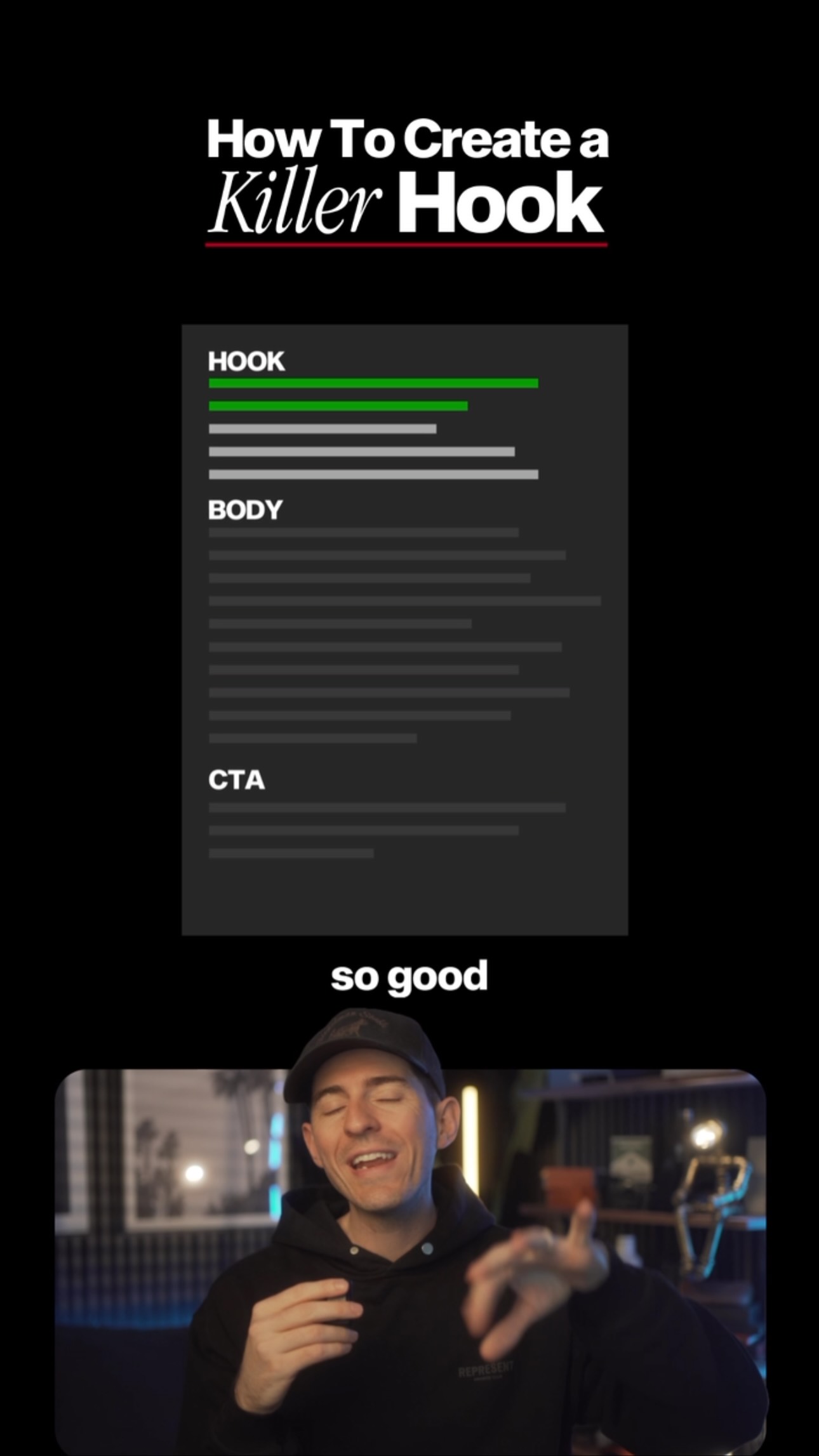
Here’s how to write a hook so good it is scientifically impossible to skip.
Search inside any video
SavedThat transcribes your saved videos and lets you search across all of them instantly. Save this video and find any moment.
TL;DR
Learn the triple hook method to create engaging content that captivates viewers and keeps them from scrolling away. Discover how to effectively establish context and curiosity.
Chapters
- 0:00Introduction to the Triple Hook Method01
- 0:10Step 1: Establishing Context02
- 0:40Step 2: Creating Curiosity03
- 1:20Step 3: The Contrarian Snapback04
- 2:00Conclusion and Additional Resources05
Transcript
Here's how to write a hook so good it is scientifically impossible to skip. This is called the triple hook method. And if you do this right, it will hypnotize a viewer such that they physically cannot scroll away. All right, step one is the context. And this is the basic step, but so many people still get this wrong. Viewers only watch content where they have a vested interest in the topic.
So the first line of your hook must establish context on what the video is gonna be about. You can say it in the audio. Seven figure content toolkit. Show it in the visuals, write it in the text or caption, ideally all three, but the context must be established immediately. We have data that shows even delaying the context to the back half of the first sentence
increases the skip rate dramatically. So priority number one is to set immediate context as soon as possible. Now, step two in the triple hook is where most people mess up. This is called the lean. What you're trying to do is get someone curious in a certain direction. You want to make them lean in on the context to actively want to hear more. Now, you can make this lean in happen in a variety
of ways You can give some proof or stat validating the incoming claim reference a specific pain point they have or a benefit they want or share something interesting shocking or unexpected But regardless of what you pick the viewer must lean in instead of opt out. So when you read back that first one to two sentences just on its own, is the context
immediately clear? And is there some curiosity inducement that makes the viewer want to lean in for more? It's called the context lean. This is what opens the curiosity loop you hear everybody talk about. Now, step three in the triple hook is really where the money's made. Like 1% of people
know how to do this. I call it the contrarian snapback. To catch a fish, you gotta get the hook in its mouth swimming one way and then yank the line going another direction. Not to be morbid, but storytelling works the exact same way. The goal is to say something in the contrarian snapback that pulls the viewer away from the direction they were leaning. Essentially,
snapping them back down another path. That triple combination of rapidly buying into the context, leaning in based on some curiosity, and then getting snapped back in another direction is the God to your hook formula that works every single time. Now, if you want to learn how to do this in practice with examples, I've linked a video where I explain it in more detail.
Over 700,000 people have watched this and I'm telling you, it's probably the best hook training on the internet. Comment hooks and I'll send it to you so you can watch it.
on the internet. Comment hooks and I'll send it to you so you can watch it.
Are you the creator or rights holder of this video? Request removal of this transcript.
Related Transcripts
 11:17YouTube
How to Create Hooks SO GOOD They Can’t Scroll Past
Tyler Tometich
 1:49Instagram
This is the ultimate guide for improving your text hooks.
Kallaway
 0:38Instagram
Here’s how to make HOOKS — Comment “film” and I’ll send you the full guide to…
Zache Seno | Content Marketing
 0:53Instagram
Comment "Hooks" for 50+ Viral Hooks 🔁 Share with a creator who needs this 👣…
Thepostprotocol | Viral Content Psychology
 0:53Instagram
comment AI for my viral hook writer… fun fact it actually helped me write the…
Mino Lee
 2:06Instagram
TikTok slideshows
Jake Coppen
Never lose a moment again
Save videos from YouTube, Instagram, and TikTok. Search everything that was said, and jump to the second.
Start Saving Videos - Free Trial