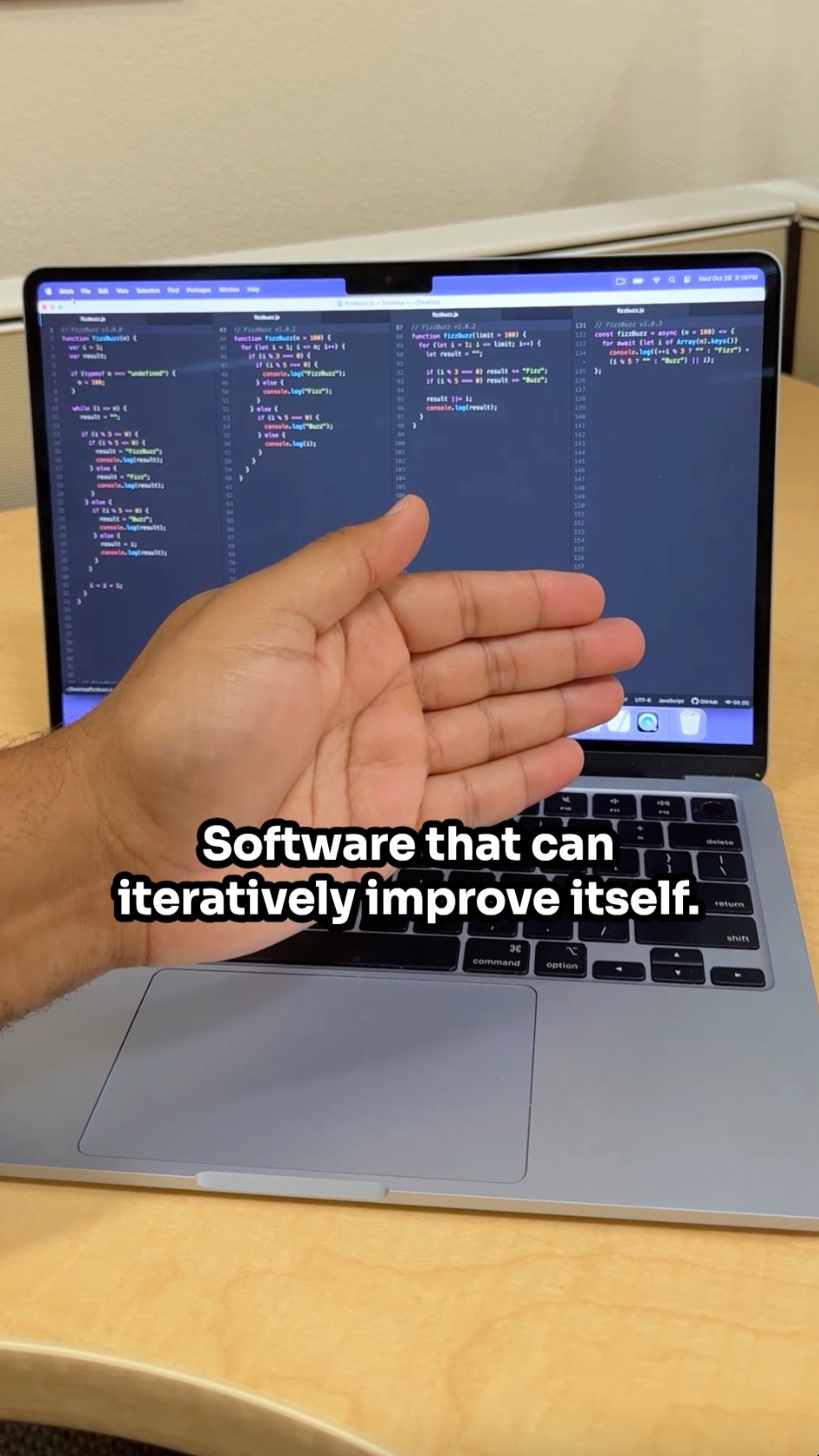
Imagine if you wrote a piece of software that could iteratively improve itself.
Search inside any video
SavedThat transcribes your saved videos and lets you search across all of them instantly. Save this video and find any moment.
TL;DR
This video explains self-improvement in software, focusing on standard and recursive self-improvement, and how to set up a self-improving code base.
Chapters
- 0:00Introduction to Self-Improvement01
- 0:30Standard vs Recursive Self-Improvement02
- 1:00Setting Up Self-Improvement03
- 1:30Transition State Search Algorithm04
- 2:00Building the Self-Improving Loop05
- 2:30Testing and Results06
- 2:46Conclusion07
Transcript
Imagine if you wrote a piece of software that could iteratively improve itself. The first day you ship it, your code is the worst it'll ever be. But then, on its own, it gets better and better and better at the task to which it is assigned. This is what we call self-improvement, and it comes in two flavors.
The kind that grabs headlines and the kind that's useful for most of us. The useful kind is just standard SI. There's a task to be done and a set of software features that perform it. But then there's also a model that runs sidecar to the primary system,
evaluating its performance and either suggesting edits or even implementing those edits itself. The other self-improvement, the headline-grabbing kind, is RSI, recursive self-improvement,
where a single system improves not only the software performing the task, but also the machinery responsible for generating the next round of suggestions and improvements. This allows the improvement process itself to improve, thus the term recursive.
But RSI is confined to the world of frontier models. If you don work at Anthropic OpenAI or Google this probably isn useful for you But SI is because in order to use it you don need to be building a frontier model You just need access to a good one, which we all have.
The question is, how do you set this up? How do you connect your code base to an agent that continually tests, benchmarks, and rewrites it? That's what this paper is all about. In it, the authors take the code for transition state search, an algorithm used in computational chemistry, and create a self-improving loop around it.
The loop performs the search, rewrites the Python code it used to do that, tests the new version, measures whether it worked better, and then uses that feedback to generate the next version. On and on, round and round, until the code that governs the search is as efficient and refined as it can possibly be.
On today's episode of Journal Club, we're going to walk through how this whole pipeline works, how the authors built it, the tools they used, the design patterns they followed, how they tested it, and the results they obtained. If you're already subscribed to our email newsletter, then you'll be getting this episode in text, audio, and video form delivered to your inbox in the next few hours.
Journal Club, the latest academic research explained in plain English.
Are you the creator or rights holder of this video? Request removal of this transcript.
Related Transcripts
 2:03Instagram
An autonomous agentic framework for cross-campaign generalization and sensor…
JournalClub.io
 31:22YouTube
Claude Code + Karparthy’s AutoResearch = GOD MODE
Lex Fridman
 1:04Instagram
comment "edit" and i’ll send the breakdown over👇 Day 4 of letting claude code…
Johannes Forseth | AI Systems
 0:31Instagram
Comment "CLAUDE" to get this Github Repo packed with Claude's AI System Prompts…
Nick Saraev
 0:37Instagram
Comment "SMART" to get this GitHub file that makes Claude instantly smarter.
Ikjot Juneja
 1:59Instagram
10 things you could do to be better than 99% of people with Claude Code.
Sheni Salami | AI & Ops
Never lose a moment again
Save videos from YouTube, Instagram, and TikTok. Search everything that was said, and jump to the second.
Start Saving Videos - Free Trial