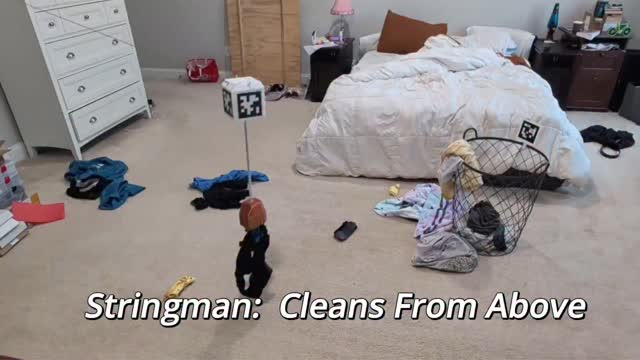
Credit: LeRobot (Hugging Face) and Nathaniel Nifong, the creator of this project.
Search inside any video
SavedThat transcribes your saved videos and lets you search across all of them instantly. Save this video and find any moment.
TL;DR
This video demonstrates the construction of a cable-driven parallel robot capable of picking up and relocating objects around a room, focusing on its design and functionality.
Chapters
- 0:00Introduction to the Robot01
- 0:10Components Used02
- 0:20Design and Mechanics03
- 0:30Training the Robot04
- 0:50Grasping Techniques05
- 1:00Conclusion and Future Work06
Transcript
Using four motors, some fishing line, and some raspberry pies, I've built a robot that can pick up anything in the room and take it somewhere else. This is one of the latest grasping models doing a laundry pick-and-place job. It's trained on about 400 examples of picking up stuff in my house. What's the cheapest way to move a gripper around a room and have enough payload capacity to pick up the laundry, trash, and toys on the floor?
I think the answer to that is a cable-driven parallel robot, or CDPR. All the motors share the load, so on average they can be smaller, and they don't need reducers, which keeps the noise to a minimum. They can be mounted on the wall instead of the moving part, so their weight doesn't matter, and there's no need for a battery. I'm supplying power to the gripper through one of the support cables.
I've trained about 20 models so far with mixed success. Though I've tried end-to-end models trained on the entire cleanup task, I've had much more success with models that are trained on the singular task of grasping objects using only the gripper camera. So for now, those overhead cameras are just used for target identification with a separate model.
The grasping is based on the same model used on Atlas from Boston Robotics, called a Multitask Diffusion Transformer. The model I've shown here is trained with LayRobot. It takes about a day on a consumer GPU, and the community frequently adds support for new model types.
Are you the creator or rights holder of this video? Request removal of this transcript.
Related Transcripts
 5:25YouTube
GPT 5.6 Sol Made This Entire Video
Nate Herk | AI Automation
 20:19YouTube
JEV: How It Works and What You Can Build
Riley Brown
 1:12Instagram
Comment PHYSICAL and I’ll send you the guide.
Ben Broch | AI Saas builder
 21:44YouTube
Dear Higgsfield, I reverse engineered you in 12 hours
Sirio
 33:23YouTube
Make Ultra Realistic AI Short Films with Fable 5 + Seedance 4K (Full Workflow)
Higgsfield AI
 17:27YouTube
Claude Fable 5 + Higgsfield MCP Will Make You Rich!
Higgsfield AI
Never lose a moment again
Save videos from YouTube, Instagram, and TikTok. Search everything that was said, and jump to the second.
Start Saving Videos - Free Trial