Search inside any video
SavedThat transcribes your saved videos and lets you search across all of them instantly. Save this video and find any moment.
Learn six psychological principles that drive virality in content creation, focusing on human behavior and how to hook viewers effectively.
I've generated over three billion views for the most boring brands you could think of. Brands that sell instant ramen software tools and cell phone plans. And after doing this for years across dozen of clients, I've come to realize that making viral content has nothing to do with the content itself. It has everything to do with how the human brains work. Every scroll, every share,
brains work. Every scroll, every share, every follow is driven by psychological triggers happening in people's brain within the first half second of seeing your content. And once you understand those triggers, you can make almost anything go viral, even if it's something as simple as instant noodles. So, in this video, I'm going to walk you through the six psychological principles
through the six psychological principles I have used to generate three billion views. And it all start with why familiarity beats originality every single time. First, number one, your brain decide before you do. You see, people do not choose what to watch. Their brains choose it for them. And it happens under a second. When you're
happens under a second. When you're scrolling, your brain is running a rapid filters. It's asking three question before you're even conscious of it. First, have I seen something this before and enjoyed it? Second, is there something unexpected happening now? And third, and does this have anything to do with me or my life? If the answer to all three is no, you
the answer to all three is no, you scroll. Because your brain doesn't register the content as something you might be interested in. This is why original content fails so often. When your brand encounter a format that has never seen before, it does not get excited. It gets confused. And confusion is the fastest path to a scroll. But
is the fastest path to a scroll. But when you use a format that your brand's already recognized, a reaction video, a challenge, or a walk up to a stranger setup, the brain goes, "I know what this is. I've liked this before. Let me watch it. There's a name for this. It's called the mere exposure effects. The more you see something, the
effects. The more you see something, the more your brands start to it. This is the backbone of what I call the format steel. You never invent content. You find a format that's already pulling millions of views and you put your brand inside that structure. When I started working with Bodak, the Korean Instagram ramen brand, they had about 300,000 followers, but they were stuck. The
followers, but they were stuck. The content wasn't going viral anymore. The follower count just came to a complete halt. So what we did was simply pivot the content style from manufacturing an ingredient to things that we going viral. We found formats in the food space spicy challenge reaction videos and we plug Bulldock into
videos and we plug Bulldock into them. The account grew to 1.8 million followers on Tik Tok and over 900 million views in 12 months. Nothing about the product changed. The format that we steal did all the heavy lifting. But creating familiar content is just one piece of the puzzle. What is even more important is laying the curioity
more important is laying the curioity trap because that is truly what hooks the viewer. Second, the curiosity trap. I've analyzed hundreds of brands and the one thing they do wrong is that they always lead with the product in their hook. Every single time they do that, your brain immediately categorize it as an ad and you scroll away before a single thought even formed. But there's
single thought even formed. But there's a loophole called the curiosity trap. When your brain sense a gaps between what it currently knows and what it wants to know. That gaps create discomfort almost a mental itch. Your brains will not let you scroll away until that gaps get filled. That is why the best hook is never about the
the best hook is never about the product. They are triggering curiosity, disbelief, or identity recognition. When I made my first video for Stan, an all-in-one creator platform, I did not open with the software. I found a format that's already blowing up. The same video everyone already see. How much do you pay for rent? We did an office tour.
you pay for rent? We did an office tour. We use the CEO stories as a location. That first video got a million views on Tik Tok and over 5 million views on LinkedIn. Over the next few months, we generated 20 million views for his personal brand. Using the same approach, the hook was about something the viewer already curious about. The product showed up naturally once they were
showed up naturally once they were already watching. Open the curiosity gap in your first two seconds and the viewer is neurologically committed to finishing. Close that got too early and they leave. That is the balance and maintaining this balance is the key to virality because our brands are not motivated by product. It's motivated by
motivated by product. It's motivated by identity state and emotional outcome. In other words, a good story. But what's even more important than the curiosity gap is to never start your content with what you sell. I know this sound weird, but just hear me out. Third, people don't buy the product, they buy identities. There's a concept called
identities. There's a concept called means and train theory. And it changed how I think about content. Every product has three layers. First, the product attributes, which is what it is. Second, functional consequences, which is what it does. Third, and the psychological values, which is what it means to the person identity and emotional life. Most
person identity and emotional life. Most brand only talk about the first layer, but your brain does not care about the first layers. It cares about the third one. Take a supplement brand for example, AG1. If you're making content about the supplement itself, you're stuck in layer one. But if you keep asking, "Why does someone care about this?" That's when you land on
asking, "Why does someone care about this?" That's when you land on something real. Supplement leads to a healthier body, which leads to better energy and mood, which leads to I feel in control of my body and my life. And suddenly you find yourself making content about sleep, stress, discipline, wellness. That is what the viewers care about. And it bypasses the
care about. And it bypasses the part where the brands lack the content as an ad. When your content speak to identity and not features, the viewer does not feel sold to. They feel understood. But here's the thing. You only have two seconds to make the viewer feel that way. And that is why the credential and your hooks change everything. The shortcut your brain
credential and your hooks change everything. The shortcut your brain cannot resist. I want to be straight up with you. Social media is shallow. And I don't mean that as an insult. this as a biological fact. Your brain does not have time to evaluate every single piece of content deeply. So it takes shortcut. And the biggest shortcut
takes shortcut. And the biggest shortcut it takes is authority. When you see credential in the first two second of a video, something Thai chef or Harvard student or a 25-year-old software engineer who sold his company, your brain does not think critically about whether this person is credible. It just accepts the credential act as a
It just accepts the credential act as a cognitive shortcut. The brain goes this person is successful or they have status. So this is worth watching. We are hardwired to pay attention to people we look up to and aspire to be . A credential in your hooks activate that reflex before the viewer even realize it. That is not manipulation. That is
it. That is not manipulation. That is how the media has always worked. You are just being intentional about it. I saw this firsthand in one of the first account I ever grown which is a red Japanese restaurant. I was making beautiful cinematic video for them. Gorgeous shots, nice music, food network quality, and they were getting maybe
quality, and they were getting maybe 200 300 views. Then I found a format that was already going viral, which is people walking up to a chef with something and asking them, "Hey chef, can you make me something gourmet?" The chefs being in a chef's outfit in a professional kitchen became the credential. The first video we made got 1.8 million views. The second
got 1.8 million views. The second video, 2 million views. They gained 300,000 followers in 3 months. Same food, same restaurant. The only thing changed is that we gave the viewer a reason to trust us within the first two seconds. But honestly, that's just half the battle. Getting the viewer to share the content is an entirely different game. People don't share what they ,
game. People don't share what they , they share what makes them look good. One of the biggest lesson I learned after generating 3 billion views is the fact that the content that gets the most shared is really the content that people personally enjoy the most. People share what makes them look smart, funny, or knowledgeable to their friends. So, when you're designing a piece of content, the
you're designing a piece of content, the question is not will they this. The question is, will sharing this makes them look good. You're not trying to impress the viewer. You're trying to impress the viewer's friend. , think of yourself as a wingman. Your job is to make the person who share your videos look they have a great taste or they discover something cool
videos look they have a great taste or they discover something cool before everyone else. That means your hook need to be explainable in one sentence. If someone cannot describe your video quickly to their friend, they will not share it. And the emotion that drives sharing are specific. Humor, surprise, and they all triggers the urge to pass something along. Sadness and
to pass something along. Sadness and anger can get views, but they do not spread the same way. Every time I'm creating a piece of content now, I ask myself, what does the person who share this get to say about themselves by sharing it? And this bring me to the last principle, which ties everything I've shared with you together. Number six, hijack the viewer's brain with
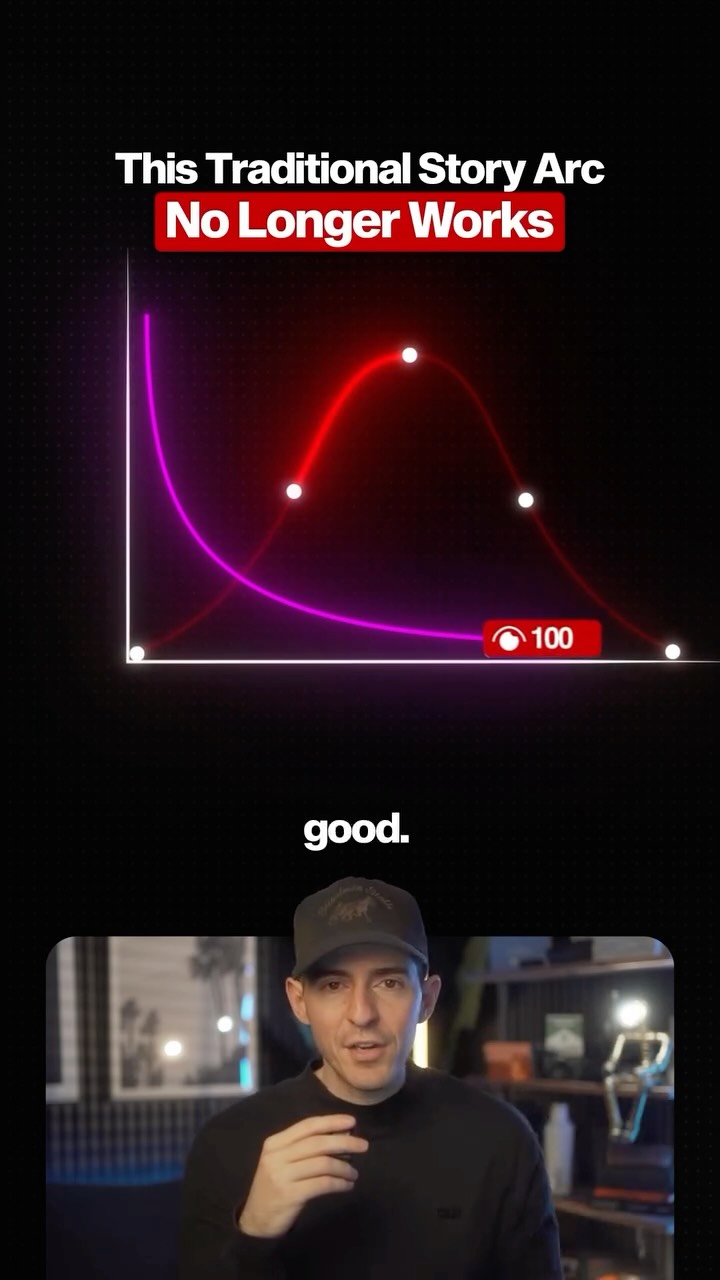
six, hijack the viewer's brain with stories. When people are inside a story, they stop arguing with what they're hearing. Their critical thinking slow down and their emotional process takes over. This is the most powerful state your viewer can be in when your brands appear. Every video I produce follow the same skeleton. Hook, then the problem,
same skeleton. Hook, then the problem, then the story, then the payoff. That structure works because it mirrors how the brain naturally process information. It create full brain engagement rather than the analytical processing that makes people skeptical. And this extends to editing too. If a frame is not delivering new informations, it gets
delivering new informations, it gets cut. Every millisecond matters because the brain is hardwired to tune out anything that stop giving it something new. And every cuts reset that clock and the caption are not optional. When you process both visuals and audio information simultaneously, it activate multiple neural pathway at once. That dual processing keep the brands locked
dual processing keep the brands locked in and boost retention. I pull up the timeline of the bod that got 2.2 million views. Every clips was barely a few seconds. Every video delivered new information with zero dead space. That is what it takes. So these are the six things I learned over the past few years. Whenever you're creating content,
things I learned over the past few years. Whenever you're creating content, the product is almost irrelevant. What matters is whether you understand the person that's watching. Bodak did not hit 900 million views because instant ramen is exciting and that Japanese restaurant did not gain 300,000 followers because of the food get better. And we did not hit 20 million
followers because of the food get better. And we did not hit 20 million view for stand because the software changed. Every one of those result happens because we understood how people think, what catch their attention and what makes them share. The product just happened to be there. The brand that stopped shooting social media as a billboard and just shove product into
billboard and just shove product into people face and create content that delivers values to people, putting people first are the brands that win because they care, because they understand people. And if you understand people, you can make anything go viral. I hope this video helped. Thanks for watching and I'll see you in the next
Lex Fridman
Grow Acquisition
Sesto elemento
Nick Saraev
Robert Gutierrez
Bryan Johnson
Save videos from YouTube, Instagram, and TikTok. Search across all your transcripts with AI-powered semantic search.
Start Saving Videos — It's Free