What makes Reels go viral: 2,635 analyzed (2026)
What makes Reels go viral, measured on 2,635 recent Reels and TikToks: breakouts look exactly like the creator's flops. The topic is what changes.
Every creator has asked it after a flop: what makes Reels go viral, when the next video looks the same and gets a tenth of the views? Most answers are lists of hooks. We wanted numbers, so we took a large set of fresh videos, found the ones that beat their own creator's normal reach by a wide margin, and compared them with that creator's ordinary uploads.
The result surprised us. On structure, the breakouts and the flops are twins.
How we measured what makes Reels go viral
The method is the part that matters, because "viral" means nothing without a baseline. A Reel with 50,000 views is a hit for a creator who usually gets 3,000 and a miss for one who usually gets 400,000.
- The pool: 2,635 English-language Reels and TikToks, plus silent videos with English on-screen text, from more than 550 creators in 14 niches. Breakouts were posted between June and early November 2026, and almost all within the last 45 days.
- The baseline: for every creator we pulled their recent videos and took the median views, excluding the video itself and anything younger than three days.
- Breakout: at least 3x that median and at least 10,000 views. There are 1,027 of them. The median breakout did 8x the creator's usual views, with a median of about 162,000 views.
- Ordinary: 1,445 videos from the same creators at 0.5x to 1.5x their median. Median 0.8x, about 12,000 views.
- In between: 163 videos at 2x to 3x, kept as a separate group.
Every video was broken down by an AI model watching and listening to the whole thing. It logged the hook (the first words and the first frame), the beats, on-screen text, captions, cuts, music and calls to action, then named the format in plain words. Same model, same instructions, for breakouts and ordinary videos alike.
Finding 1: breakouts are built exactly like flops
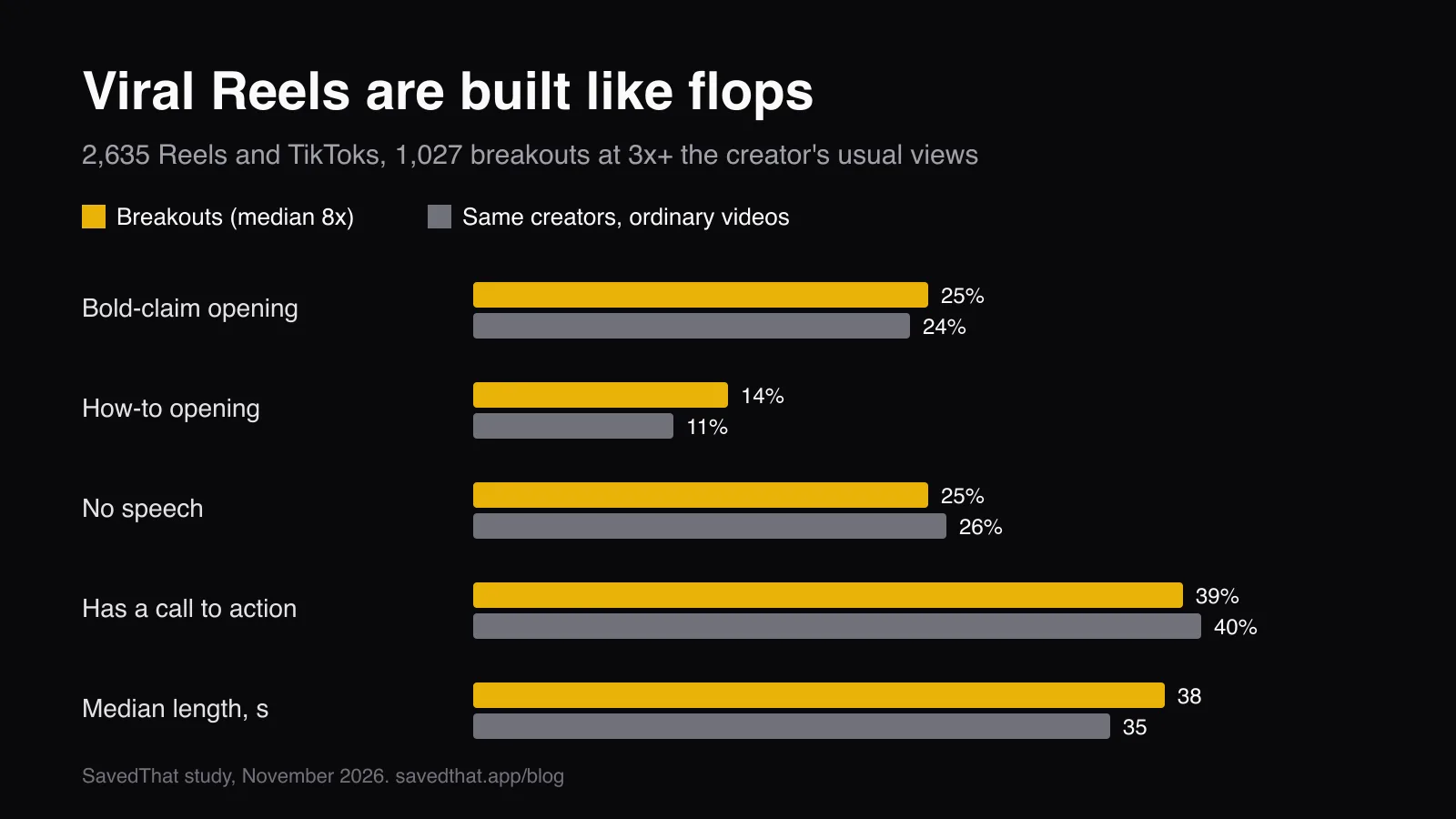
If viral Reels had a secret structure, it would show up here. It does not.
| Breakouts (3x+) | 2x to 3x | Ordinary (about 1x) | |
|---|---|---|---|
| Videos | 1,027 | 163 | 1,445 |
| Open with a bold claim | 25% | 28% | 24% |
| Open with a how-to | 14% | 12% | 11% |
| Open with a question | 7% | 10% | 9% |
| Meme or trend, no spoken hook | 8% | 6% | 9% |
| Show it first, talk later | 9% | 8% | 9% |
| Numbered list | 5% | 7% | 4% |
| No speech at all | 25% | 25% | 26% |
| Has a call to action | 39% | 41% | 40% |
| Median length | 38 s | 36 s | 35 s |
The differences are a few percentage points at most. How-to openers and numbered lists show up slightly more often in breakouts, which matches what we saw in a smaller pilot earlier this month. But a creator who copies "the viral hook" is copying something that their flops already had.
Three practical consequences:
- Length is not the lever. Breakouts run a median 38 seconds, ordinary videos 35.
- Captions and text on screen are not the lever either. One video in four has no speech in both groups.
- A call to action does not hurt reach. Comment-a-word and follow prompts appear at the same rate in both groups.
Finding 2: what makes Reels go viral is the topic
If not the structure, then what? In our first pass we compared each breakout's topic with the topics of the same creator's ordinary videos, across 139 creators who had both.
A breakout's topic was far less similar to the creator's usual topics than their ordinary videos were to each other: an average similarity of 0.056 against 0.090, measured on text embeddings of the one-line topic. In plain words, a breakout is the creator's familiar format aimed at a subject they do not usually cover, and that subject is having a moment.
The topics that over-indexed in breakouts were the ones in the news that week: a new AI feature everyone was trying, a platform policy change, a deal or price people were searching for. The format was the delivery truck. The cargo was new.
What is going viral right now, niche by niche
Here are the breakouts from the last 45 days by niche, with the median multiple and the most common opening. Travel and fitness had the strongest median breakouts. Finance and food had the mildest.
| Niche | Breakouts | Median multiple | Most common opening |
|---|---|---|---|
| AI tools | 240 | 7.7x | Bold claim |
| Coaching | 128 | 8.3x | Bold claim |
| Account growth | 104 | 7.1x | How-to |
| Food and recipes | 77 | 5.2x | How-to |
| AI agents and Claude tips | 52 | 7.3x | Bold claim |
| Fashion | 46 | 7.8x | How-to |
| Design and editing | 44 | 8.4x | How-to |
| Small business | 44 | 7.6x | Show it first |
| Travel | 42 | 12.1x | Bold claim |
| Beauty | 35 | 6.2x | How-to |
| Fitness | 33 | 8.7x | How-to |
| Money and finance | 28 | 4.9x | Bold claim |
| Real estate | 26 | 7.2x | Bold claim |
| Productivity | 20 | 5.6x | Bold claim |
A few breakouts that show the pattern, described rather than named:
- Food: a point-of-view air fryer s'mores dip demo did more than 1,600x its creator's usual views. The creator's ordinary uploads used the same POV recipe format on everyday dishes.
- Travel: a former flight attendant listing flight-booking tricks reached roughly 1,000x the account's normal views. The list format was the creator's standard. Booking hacks were a new subject for the account.
- Account growth: a step-by-step tutorial turning one photo into a TikTok video did several thousand times the creator's median. Same tutorial format as always, aimed at a brand-new AI feature.
- AI agents: a Claude Code efficiency trick using a second coding agent did about 260x. The creator's ordinary uploads covered coding agents generally.
Extreme multiples like these come from small accounts, where the median is a few hundred views and one hit moves the ratio enormously. The median breakout, 8x, is the more useful number for planning.
Why your Reels don't go viral (and what to change)
If structure barely differs, then "fix your hook" is advice for a different problem. A weak hook loses viewers in the first seconds, and Instagram's own retention chart, which shows the share of viewers still watching at each moment, will tell you if that is happening (Social Media Today). Instagram's guidance is that the line always slopes down, and a flatter line means a more engaged audience.
But a video can hold viewers well and still reach nobody new. That is the topic problem. What we would do, based on these numbers:
- Keep the format you already execute well. Your ordinary videos and your breakouts share it. Switching formats resets your skill, not your reach.
- Change the subject before you change the format. Look for what moved in your niche this week: a new feature, a rule change, a price, a story people are searching for. Point your proven format at it.
- Judge a Reel by its multiple, not its view count. Divide its views by your median. 3x is a breakout for your account size; compare yourself with yourself (Inro).
- Read the retention chart only after the topic test. If the curve drops hard in the first three seconds, fix the opening. If it holds but reach is flat, the topic did not travel.
Limits of this study
- English only. We excluded other languages on purpose, because our readers are mostly in the United States and Latin America.
- Instagram and TikTok only, found through creator-term searches such as "meal prep", "capcut tutorial" and "claude code". Niches we did not search are not represented.
- Views are a snapshot. A breakout from last week may still be growing, so its multiple is a floor.
- The topic finding comes from 139 creators with enough videos on both sides. The structure finding uses all 2,635 videos.
- We cannot see the distribution side. We do not know which videos were pushed to non-followers or how saves and shares were weighted. We only see the result.
We will re-run this every month. The niche table is the part most likely to change.
Keep reading
What people actually save: a data study (2026)
What people actually save, measured: 558 videos, 622 saves and 358 searches on SavedThat. Short-form wins the count, YouTube holds 90% of the spoken words.
Instagram Reels search by spoken words (2026)
Instagram Reels search by spoken words is still not native, even with Instagram's new Saved search. Four workarounds that find a Reel by what was said.
Transcribe saved Reels and search them (2026)
Transcribe saved Instagram Reels and search the transcripts: what Instagram gives you, the apps that do it automatically, and the DIY Whisper route.
Frequently asked questions (2026)
What makes Reels go viral in 2026?
In our study of 2,635 recent Reels and TikToks, breakouts and the same creators' ordinary videos had nearly identical hooks, length, captions and calls to action. The difference was the topic: breakouts aimed a creator's usual format at a subject that was hot that week.
What counts as a viral Reel?
We call a Reel a breakout when it gets at least 3 times the creator's median views and at least 10,000 views. The median breakout in our data did 8 times the creator's usual views.
Does Reel length affect going viral?
Barely. The median breakout ran 38 seconds and the median ordinary video 35 seconds. Length was not what separated hits from misses.
Which hook works best on Instagram Reels?
Bold claims open about a quarter of both breakouts and ordinary videos. How-to openers and numbered lists appear slightly more often in breakouts, but the gap is a few percentage points, so the hook alone does not explain a hit.
Why do my Reels not go viral when they look like viral ones?
Because the structure is probably not the problem. Check your topic: breakouts covered subjects the creator does not usually cover and that were moving that week. Then use the retention chart to see whether the opening loses people.
Which niches have the biggest breakouts right now?
Over the last 45 days, travel (median 12.1x) and fitness (8.7x) had the strongest median breakouts, and AI tools had the most breakouts in total (240). Finance and food had the mildest median multiples.
How can I find trending Reel formats in my niche?
SavedThat's Formats tab lists the formats getting 3x or more views right now in 14 niches, with a full breakdown of each example and a version of the script rewritten for your own topic.