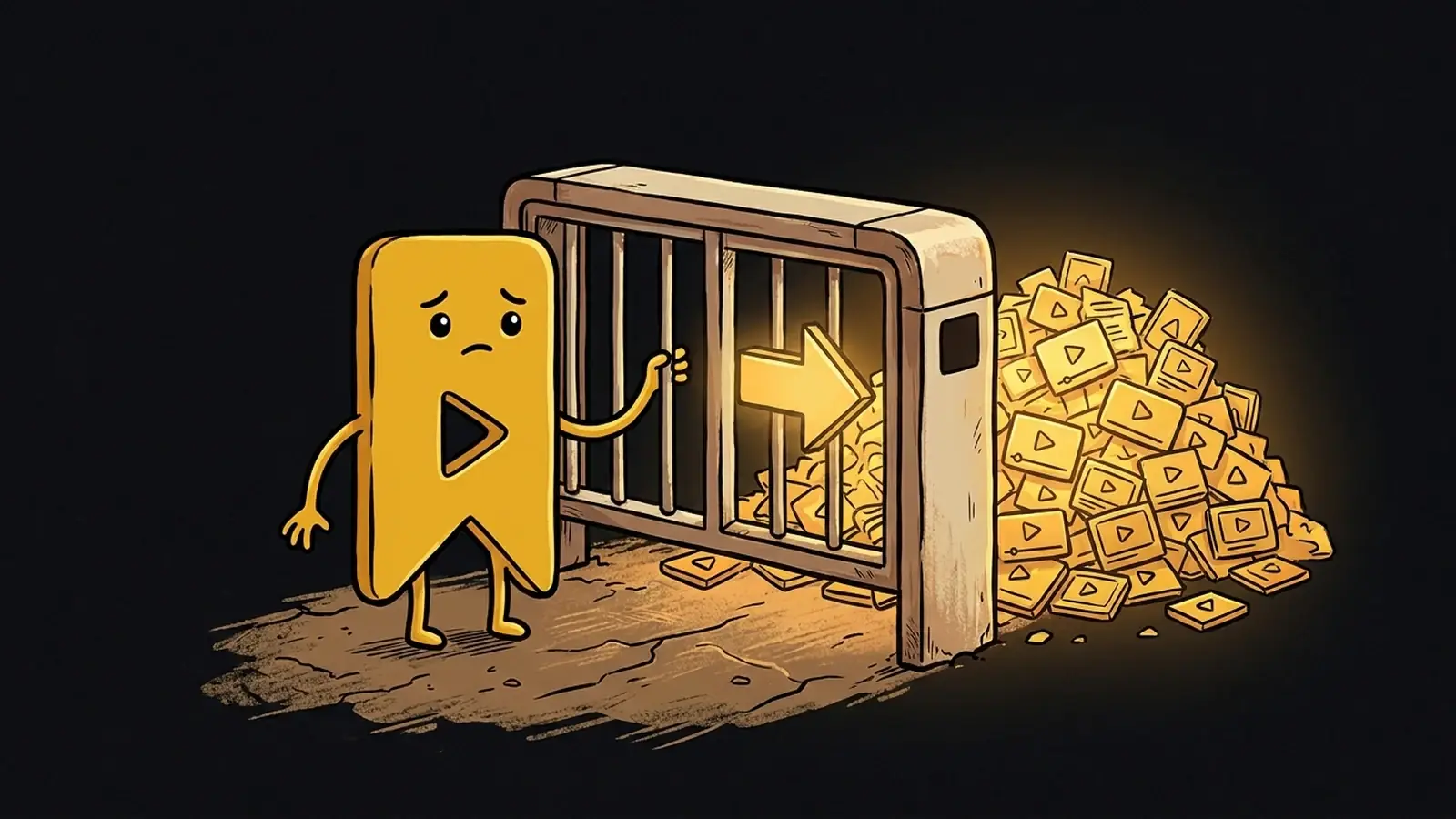
Why you never revisit what you save (and what actually fixes it)
Why you never revisit saved content: the save-then-forget loop is well diagnosed and rarely built against. What we shipped, and the three popular fixes we refused.
The diagnosis is done. It's been done several times over.
Two recent write-ups make the case cleanly. Startwinklerana's analysis calls it the "Save-Then-Forget Loop": saving functions as a psychological closure mechanism, signalling to your brain that the content has been handled, which removes the urgency to ever return. Abhishek Deshpande's piece arrives at the same place from the retrieval side: what you remember about a Reel is the idea or the vibe, not the caption or the creator, and no platform lets you search on that.
Add the recurring Reddit threads about "digital hoarding," add the fact that every Instagram user you know has a Saved folder they describe with a small apologetic laugh, and the picture is settled. Nobody needs another post explaining that the save button is a trap.
The gap is on the other side. The Startwinklerana piece ends at the design proposal, which is the normal shape of the genre and not a criticism. Deshpande goes further: he's building his version and documents real course corrections along the way, including abandoning embeddings-only search once it produced noisy results, which is precisely the wall we hit and solved with hybrid retrieval.
What's still missing from both, and from nearly everything else written on this, is the account of what the fixes look like after they exist. That's the part with the surprises in it.
We built it. Here's the honest version.
The five fixes everyone proposes
The Startwinklerana piece lists five, and it's a good list, which is why it's worth arguing with specifically:
- Smart resurfacing. Show me the thing I saved three days ago and never opened.
- AI categorisation. Auto-group saves into Learning / Entertainment / Important.
- Time-based nudges. Surface saved content when I'm actually free, not at 11pm on a Wednesday.
- Priority and intent tagging. Let me mark a save Urgent / Casual / Later at the moment I save it.
- Consumption progress tracking. Show me "you've engaged with 6 of your 20 saves this week."
One caveat before going further. That piece estimates the saved-to-viewed conversion rate at "under 15%" across platforms, and is explicit that this is an estimate, not a measurement. It gets quoted around as a statistic. It isn't one. No platform publishes this number, and we should all stop laundering a reasonable guess into a fact.
We built #1, built a crude version of #3, and refused #2, #4 and #5. The refusals are the interesting part, so they get the longer section.
What we built: resurfacing, in two places
Inside the app. There's a horizontal row on the library home that pulls your oldest ready saves, not your newest. It only considers saves older than 14 days, deduplicates against the recent-saves row directly above it, and shuffles so the order varies between visits. (The set only rotates once you have more than six qualifying saves, which is a limitation we accept rather than a feature.)
The constraint that took the longest to get right: if it can't find at least three qualifying saves, the row hides completely. A resurfacing feature that pads itself with last Tuesday's save to avoid looking empty is worse than no feature, because it teaches you within two visits that the row is decorative.
Outside the app. A weekly job looks for dormant users, meaning zero saves and zero searches in the trailing seven days, who have a library worth resurfacing. It picks one saved video and sends a single nudge. If you have push notifications on, it goes to push. If you don't, it goes to email. Never both, which sounds obvious and required a specific database query to guarantee.
The number that mattered most there was the floor between nudges. The obvious cap is weekly, and the proposal linked above suggests "maximum one nudge per week total." We set the default to 21 days.
The reasoning: a dormant user is by definition someone who did not come back. Nudging that person every seven days is not re-engagement, it's attrition with extra steps. Once a month is roughly the frequency at which a message about your own saved library can still read as a favour rather than as a product trying to hit a retention number.
The rule that mattered more than the algorithm
Our primary user is what we internally call the Overwhelmed Saver: saves things constantly, with real intent, almost never returns. The dominant emotion is not curiosity. It's guilt, with a side of overwhelm.
That single fact constrains the copy harder than it constrains the code. There's a rule written into the component itself: never "you forgot these," never "you never opened these," and nothing that counts your unwatched saves back at you. The row is labelled Rediscover, and the subtitle is a variation on a few worth another look.
This sounds like fussing over microcopy. It isn't. For a user whose relationship with their saved folder is already mildly shameful, a resurfacing feature written in a scolding voice is a guilt amplifier with a nice animation. The most likely response to it is not opening the video. It's uninstalling the app, so the reminder stops.
What we refused to build, and why
Progress tracking
The proposal: show users "you've watched 6 of your 20 saves this week," on the well-supported grounds that progress feedback drives behaviour change, as with Duolingo streaks or reading apps.
The mechanism is real. The analogy doesn't transfer.
A Duolingo streak is something you built. It only exists because you did the thing, and it counts up from zero. "6 of 20" is a different object entirely: it's a debt statement. It counts what you owe. The remaining 14 aren't an achievement in progress, they're a backlog with your name on it, and the number goes up every time you save something new, which is the exact action the product wants to be frictionless.
So progress tracking on saved content converts the core loop into a chore ledger. For a user whose dominant emotion is already guilt, that's not a motivation mechanic, it's the same guilt with a percentage next to it. We didn't build it and we don't currently plan to.
Priority tagging at save time
The proposal: three buttons at the moment of saving, Urgent / Casual / Later, so the library has real priority instead of being a flat pile.
The signal would genuinely be useful. The cost lands in the wrong place.
Saving has to cost about what liking a tweet costs, or people stop doing it. That's not a preference, it's the constraint that determines whether the library exists at all. Every tap you add to the save flow is paid for by the saves that never happen, and those saves are invisible: you can't A/B test the video someone didn't bother to capture because a modal appeared.
There's a second problem specific to this feature. The moment of saving is the moment of least information. You're mid-scroll, you haven't watched the whole thing, and you don't know yet whether it's urgent. Asking for a priority judgement there produces noisy tags, and noisy tags are worse than no tags because they look authoritative in the interface.
We wrote about the same failure from the other direction in YouTube → Notion → nowhere: manual tagging degrades to generic labels like interesting within the first fifty entries, and stops happening at all somewhere around entry 350.
AI categorisation into buckets
The proposal: auto-sort saves into Learning / Entertainment / Important so the library feels manageable.
This one we refused on a stronger claim: buckets are a workaround for retrieval that doesn't work.
Think about why folders feel necessary. They're necessary when the only way to find something is to narrow down where you're looking. If you can describe the thing you half-remember and get it back, the buckets are ceremony. You don't file your email into folders to find a message from your accountant, you search "accountant."
So the bucket proposal is, in our reading, a symptom of the same underlying gap the articles identify. Platforms can't search inside your saves, so the best available fix is to shrink the pile you have to scan by hand. That's a rational response to a broken search box. It's the wrong thing to build if you can just fix the search box, which is what semantic search over transcripts does.
Categories are also lossy in a specific, annoying way. A cooking video from a chef who explains the food science is Learning and Entertainment, and which bucket it lands in is a coin flip you'll have forgotten by the time you look for it.
The part where we don't have an answer
We can't tell you yet whether resurfacing works.
Our user base is small enough that any conversion figure we published would be noise dressed as evidence, and a meaningful share of the activity in our own database is our own testing. Publishing "resurfacing lifted revisits 40%" off a base like that would be exactly the kind of number that ends up misquoted in someone else's post, which is the thing we complained about four sections ago.
What we can say is what we'd need to see before believing it:
- Revisit rate among nudged dormant users versus a held-out group. Not opens of the nudge. Opens of the video, and ideally a search afterwards, which is the behaviour that indicates the library became useful rather than just briefly visible.
- Whether the in-app row cannibalises or adds. If the resurfacing row just redistributes the same number of video opens away from the recent row, it's decoration.
- Notification dismissal rate holding flat. A nudge that lifts revisits while training people to swipe away everything from us is a loan, not a win.
Ask anyone claiming a resurfacing win for the third one specifically. It's the one that's usually missing.
The short version
Saving isn't broken. Intent isn't missing. People tap that bookmark icon with complete sincerity, dozens of times a week.
What's missing is that the save button was built and the way back never was. That much is now consensus. The useful work left is downstream of the diagnosis, in the unglamorous decisions: how often you're allowed to interrupt someone about their own library, what voice you use when you do, and which of the obvious-sounding fixes quietly make the problem worse.
Our summary of those decisions, for whatever it's worth to the next person building this: resurface old things without commentary, never charge a tax at save time, and fix retrieval instead of building folders on top of retrieval that doesn't work.
Frequently asked questions (2026)
Why not just remind people about everything they saved?
Because the reminder competes with an infinite algorithmic feed, and it loses. More importantly, the failure mode is asymmetric: a nudge that gets ignored doesn't cost you nothing, it trains the user to dismiss your notifications reflexively. That's why the default gap between our dormant nudges is 21 days rather than the more common weekly cadence.
Does resurfacing mean the app decides what I see, like a feed?
Not in the ranking sense. The in-app row selects on age (saves older than 14 days that aren't already in the recent row) and shuffles lightly for variety. There's no engagement-optimised model deciding which of your saves deserves attention. The point is to counteract recency bias in your own library, not to build another algorithmic surface.
Isn't semantic search enough on its own? Why nudge at all?
Search only helps people who remember they have something to search for. The Save-Then-Forget Loop means saving itself creates the feeling that the item is handled, so the user never forms the intent to go looking. Search fixes retrieval. Resurfacing fixes the missing intent. They solve different halves of the problem.
What would change your mind about progress tracking?
Evidence that the counter reads as accomplishment rather than debt for this specific user. That would most likely require framing it as a count-up of what you revisited, with no denominator and no reference to the unwatched remainder. A '6 of 20' framing we'd still expect to backfire, because the 20 grows every time the user does the thing the product wants.